Understanding the C scale, ISO scope, and SWAAT testing for aluminium microchannel heat exchangers
In corrosion protection, it is common to hear expressions such as “C5 coating”, “C5 certified coating”, or “ISO 12944 C5 certified aluminium microchannel.” However, these expressions can be misleading.
There are three important points to understand.
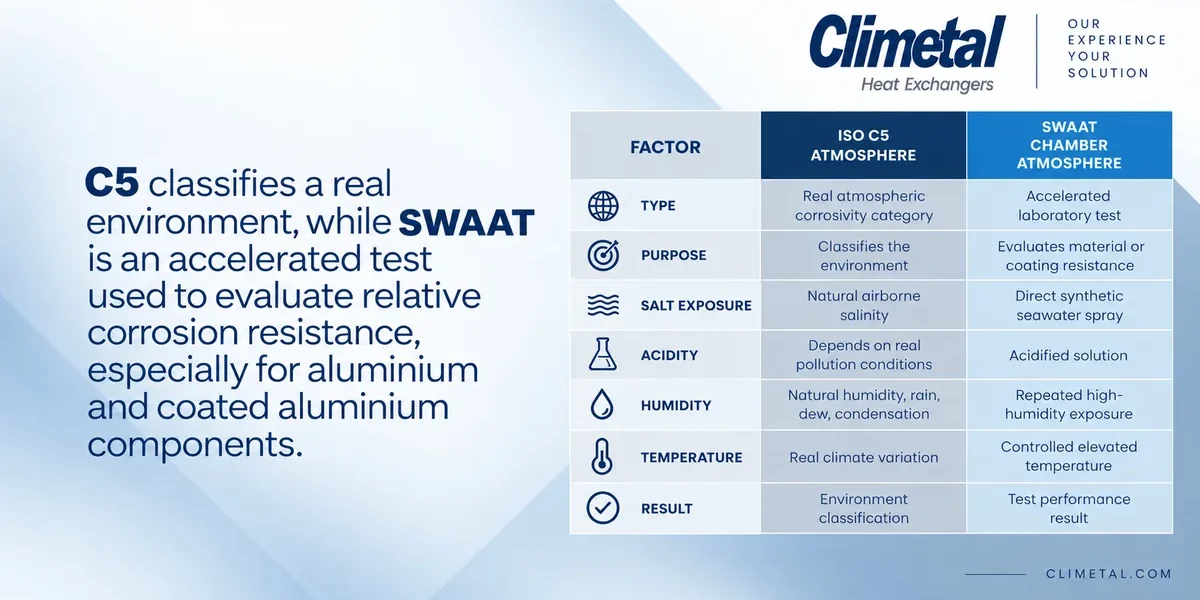
The C scale measures the environment, not the coating
The C scale is used to classify the corrosivity of an environment.
It helps answer this question:
How aggressive is the atmosphere where the equipment will operate?
For example, C1 refers to a low-corrosion environment, while C5 refers to a very aggressive atmosphere, often related to coastal or industrial exposure.
So, C5 describes where the product operates, not what the coating is.
A more accurate way to say it is:
“A coating system tested for use in a C5 environment.”
ISO 12944 has a scope limitation
There is also an important limitation when talking about aluminium microchannel heat exchangers.
ISO 12944-6 is written for protective paint systems on carbon steel structures.
It is not specifically written for aluminium brazed microchannel heat exchangers.
This matters because a microchannel heat exchanger is not a simple steel structure. It is an aluminium heat transfer component with thin fins, tubes, headers, brazed joints, and narrow air passages.
A coating that works on a steel test panel does not automatically prove that it is suitable for an aluminium microchannel heat exchanger.
For microchannels, the coating must do two things at the same time:
- Protect the aluminium from corrosion
- Preserve heat transfer, airflow, drainage, and pressure drop performance
Because of this, saying “ISO 12944 C5 certified aluminium microchannel” can be misleading.
How SWAAT testing fits in
For aluminium microchannel heat exchangers, SWAAT testing provides a relevant method for assessing the unit’s corrosion resistance.
The ASTM G85 A3 SWAAT method is applicable to aluminium alloys and is widely used to evaluate the corrosion performance of aluminium heat exchanger components and protective coatings.
The SWAAT test exposes the unit to an aggressive accelerated environment combining acidified synthetic seawater spray, high humidity, and elevated temperature in repeated cycles.
This provides valuable evidence of the corrosion resistance and durability of aluminium components and their protective coatings under severe test conditions.
For microchannel heat exchangers, SWAAT results provide a practical and material-relevant benchmark for comparing corrosion protection solutions.
They allow different coatings to be evaluated under the same controlled and demanding conditions, providing clear, measurable data to support coating selection for applications where corrosion resistance is a key requirement.
For aluminium microchannel heat exchangers, SWAAT can be a strong validation tool because it tests the coating on the actual type of material and geometry used in the product.
Key takeaway
✓ C5 is an environment classification, not a coating certification.
✓ ISO 12944-6 applies to protective paint systems for carbon steel structures, not directly to aluminium microchannel heat exchangers.
✓ SWAAT is an accelerated corrosion test that is highly relevant for aluminium and coated aluminium components, but it is not a direct equivalent to C5.
✓ For aluminium microchannels, corrosion protection must be validated on the real product geometry, not assumed from a generic C5 coating claim.
For more information, contact our team climetal@climetal.com
CLIMETAL – OUR EXPERIENCE, YOUR SOLUTION.